Most people don’t think much about their air conditioner until it suddenly stops working.
One day the cooling feels slightly weaker, the airflow seems unusual, or a strange sound starts coming from the unit. At first, these signs may seem minor and easy to ignore. But in many cases, small AC problems quickly turn into expensive repairs when they are left untreated.
An air conditioner rarely fails without warning.
Most systems show clear signs that something is wrong long before a complete breakdown happens. The problem is that many homeowners wait too long to take those signs seriously.
Ignoring early AC issues can lead to higher electricity bills, poor cooling performance, damaged components, reduced indoor comfort, and even complete system failure during peak summer months.
That’s why it’s important to recognize when your AC needs immediate professional attention.
In this guide, we’ll explore the most common warning signs your AC needs repair, what those symptoms usually mean, and why acting early can save you significant money, stress, and discomfort.
Weak or Inconsistent Cooling
One of the most obvious signs your AC needs repair is weak cooling performance.
If your air conditioner is running continuously but the room still feels warm or uncomfortable, something inside the system may not be functioning properly.
In some cases, cooling may feel uneven throughout the house. One room may feel cold while another remains noticeably warmer.
This issue can happen for several reasons, including low refrigerant levels, clogged air filters, compressor problems, thermostat malfunctions, dirty evaporator coils, or restricted airflow.
Many homeowners assume weak cooling simply means the AC is getting old, but that is not always true. Sometimes a relatively small repair can restore full efficiency if the issue is diagnosed early.
The longer weak cooling continues, the harder the system must work to maintain temperature, which increases both wear and electricity consumption.
Strange Noises Coming From the Unit
Air conditioners naturally make some operational sounds, but loud or unusual noises are often warning signs of mechanical problems.
If you begin hearing grinding, banging, screeching, rattling, buzzing, or clicking sounds, the system may require immediate inspection.
Different sounds can indicate different issues. Loose components may create rattling noises, damaged motors can produce grinding sounds, and electrical problems sometimes create buzzing or clicking.
Ignoring unusual noises is risky because mechanical problems often become worse over time. A small loose component today can eventually damage larger and more expensive parts inside the system.
In many situations, early repairs prevent complete system failure.
Unusual Smells From the AC
Your air conditioner should never produce strong or unpleasant odors.
If you notice musty smells, burning odors, or chemical-like scents coming from the vents, your AC system may need urgent attention.
A musty smell often indicates mold or moisture buildup inside the unit or ductwork. Burning smells can point toward overheating electrical components or wiring issues.
Sometimes refrigerant leaks can also create unusual chemical odors.
These issues should never be ignored because they can affect both system performance and indoor air quality.
In some cases, electrical odors may even indicate potential fire hazards.
Rising Electricity Bills Without Explanation
A sudden increase in electricity bills is often one of the earliest signs of AC inefficiency.
If your usage habits have not changed but your energy bills continue increasing, the air conditioner may be working harder than necessary due to hidden mechanical issues.
Dirty coils, refrigerant leaks, failing compressors, airflow restrictions, thermostat problems, and aging components can all reduce efficiency significantly.
As the system struggles to cool your home, it consumes more electricity while delivering weaker performance.
Many homeowners ignore this warning sign because the AC still technically works. However, declining efficiency often signals underlying problems that eventually become much more expensive.
Addressing repairs early can improve cooling performance while reducing monthly operating costs.
Warm Air Coming From Vents
If your AC is blowing warm air instead of cool air, something is clearly wrong.
This problem can happen because of thermostat issues, low refrigerant levels, compressor failure, electrical problems, or airflow restrictions.
Sometimes the issue is simple, but in other situations it may indicate serious compressor damage.
Regardless of the cause, warm airflow should never be ignored, especially during hot weather.
A system that cannot cool properly often experiences increased internal stress, which may accelerate component failure.
Poor Airflow Throughout the Home
Weak airflow is another major warning sign.
If air barely comes through the vents even when the system is running, the AC may be struggling with blocked ducts, dirty filters, blower motor problems, or airflow obstructions.
Poor airflow not only reduces comfort but also places additional strain on the entire cooling system.
Over time, restricted airflow can affect evaporator coils, increase system pressure, and reduce overall efficiency.
Professional inspection is usually necessary to identify the exact cause.
Frequent Cycling or Constant Running
Air conditioners naturally cycle on and off throughout the day.
However, if the system turns on and off too frequently or runs almost nonstop without reaching the desired temperature, it may require immediate repair.
Short cycling can result from thermostat issues, refrigerant imbalances, overheating components, electrical faults, or improper system sizing.
Constant operation usually indicates that the system is struggling to cool efficiently.
Both problems increase wear on major components and can shorten the lifespan of the AC unit.
The earlier these issues are corrected, the lower the risk of major breakdowns.
Water Leaks Around the Unit
Air conditioners naturally produce condensation, but visible water leaks around the indoor unit are not normal.
Leaks may occur because of clogged drain lines, frozen evaporator coils, damaged drain pans, or excessive moisture buildup.
While small leaks may not seem serious initially, water damage can quickly affect walls, ceilings, flooring, and surrounding structures.
Moisture problems can also contribute to mold growth and poor indoor air quality.
If you notice pooling water or excessive moisture around the system, professional repair should not be delayed.
Frozen Evaporator Coils
Frozen coils are a common sign that airflow or refrigerant problems exist inside the system.
If you notice ice buildup on the indoor unit or refrigerant lines, your AC may be experiencing restricted airflow, dirty filters, low refrigerant levels, or blower motor issues.
Many homeowners mistakenly assume ice means the AC is cooling extremely well.
In reality, frozen coils usually indicate that the system is under stress.
Running an AC with frozen coils can damage compressors and other expensive components.
Immediate inspection is important to prevent larger repairs.
AC Takes Too Long to Cool the House
If your home takes much longer than usual to reach the desired temperature, your AC may already be losing efficiency.
Over time, internal components wear down and cooling performance gradually declines.
This can happen because of refrigerant leaks, compressor inefficiency, dirty coils, thermostat calibration problems, or airflow restrictions.
Many people ignore slow cooling because the AC still eventually works.
However, declining performance often signals deeper mechanical issues that worsen over time.
Excess Humidity Indoors
An air conditioner does more than cool the air.
It also helps control indoor humidity.
If your home suddenly feels unusually humid or sticky even while the AC is running, the system may not be functioning correctly.
Humidity issues can occur because of refrigerant problems, oversized units, dirty coils, drainage issues, or airflow imbalance.
Poor humidity control affects comfort and can also encourage mold growth and indoor air quality problems.
Bad Thermostat Performance
Sometimes the problem is not the AC unit itself but the thermostat controlling it.
If temperatures feel inaccurate, the system behaves unpredictably, or settings do not respond correctly, the thermostat may need repair or recalibration.
Modern cooling systems rely heavily on accurate thermostat communication.
Even minor thermostat problems can create inefficient cooling cycles and inconsistent comfort.
Professional diagnosis can determine whether the issue involves the thermostat, electrical connections, or the cooling system itself.
Refrigerant Leaks
Refrigerant is essential for proper cooling.
If refrigerant levels drop because of leaks, cooling performance declines significantly.
Common signs of refrigerant leaks include weak cooling, frozen coils, hissing sounds, higher electricity bills, and longer cooling cycles.
Refrigerant issues should always be handled by licensed professionals because improper handling can damage the system and create safety concerns.
Ignoring leaks forces the AC to work harder while reducing efficiency.
Over time, this can severely damage the compressor.
Burning or Electrical Smells
Electrical smells coming from the AC should always be treated seriously.
Burning odors may indicate overheating motors, damaged wiring, failing electrical components, or electrical short circuits.
These problems can become dangerous if ignored.
In some situations, continuing to run the system may increase fire risk.
If you notice persistent burning smells, turn the system off and contact a professional technician immediately.
Why Immediate Repairs Matter
Many homeowners delay repairs because the system still partially works.
Unfortunately, air conditioning problems rarely improve on their own.
Small issues often create additional strain throughout the system, causing related components to fail over time.
For example, ignoring airflow restrictions can eventually damage compressors. Refrigerant leaks can increase pressure on the entire system. Electrical problems can spread to additional components.
Immediate repairs are usually far less expensive than major system replacements.
Early intervention also helps:
- Improve energy efficiency
- Extend system lifespan
- Reduce breakdown risk
- Improve indoor comfort
- Protect air quality
- Lower operating costs
Preventive repairs are almost always cheaper than emergency replacements.
How Regular Maintenance Prevents Major Repairs
One of the best ways to avoid emergency AC repairs is through regular maintenance.
Professional servicing helps identify problems before they become serious.
Routine maintenance typically includes:
- Cleaning coils
- Checking refrigerant levels
- Inspecting electrical components
- Replacing filters
- Testing airflow
- Evaluating thermostat performance
Well-maintained systems usually operate more efficiently, experience fewer breakdowns, and last significantly longer.
Maintenance also helps technicians identify early warning signs that homeowners may not notice themselves.
Common Mistakes Homeowners Make
Many homeowners unintentionally worsen AC problems by delaying service or attempting temporary fixes.
Some of the most common mistakes include ignoring warning signs, delaying filter replacement, continuing to run damaged systems, neglecting annual maintenance, and hiring unqualified technicians.
While some issues may initially appear minor, modern air conditioning systems are highly interconnected.
A single unresolved problem can eventually affect multiple components.
That’s why professional diagnosis is often essential.
FAQ: Signs Your AC Needs Immediate Repair
How do I know if my AC needs repair?
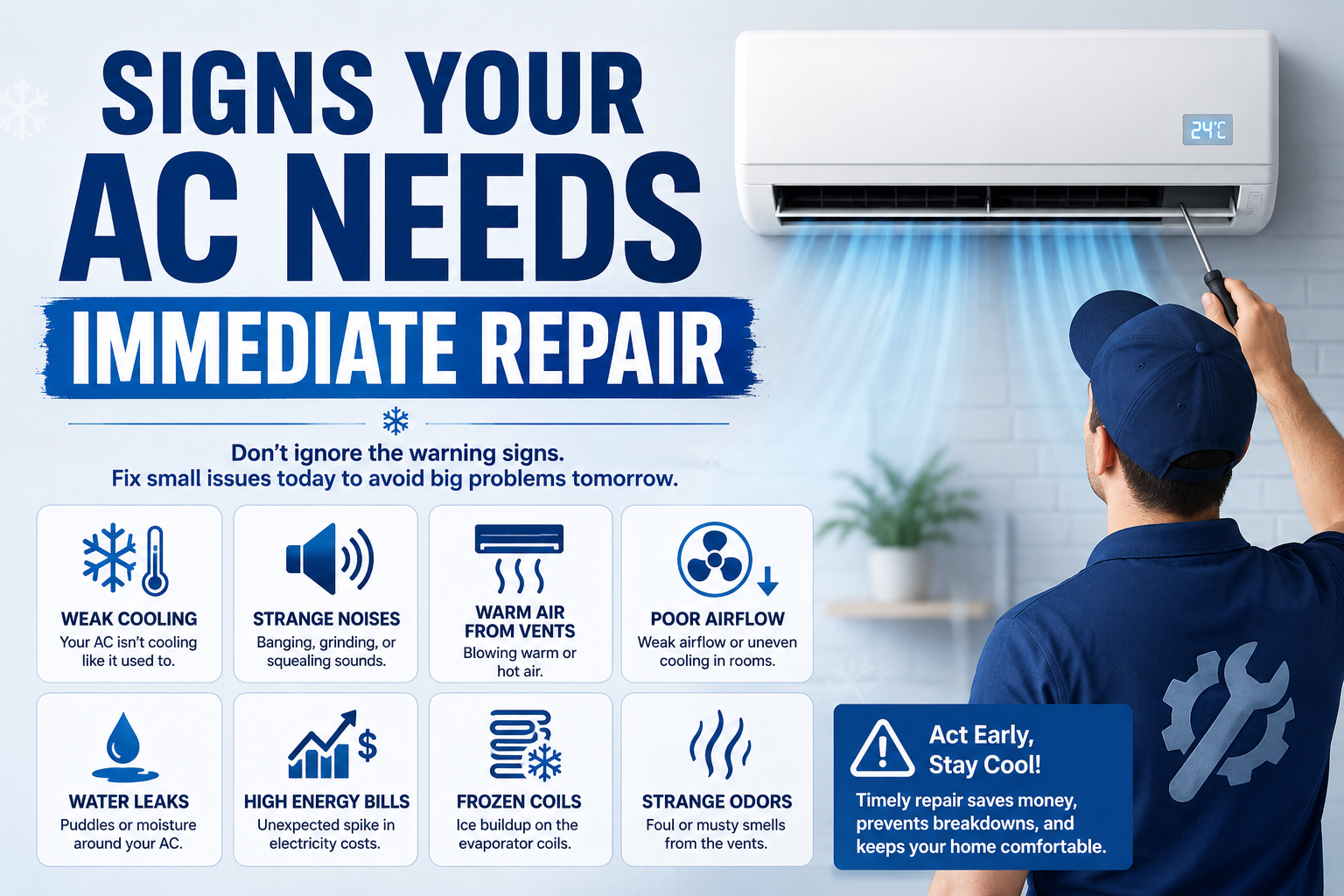
Common signs include weak cooling, unusual noises, bad smells, warm air from vents, poor airflow, water leaks, rising electricity bills, frozen coils, and frequent cycling.
Is it dangerous to ignore AC problems?
Yes. Ignoring AC issues can lead to larger mechanical failures, electrical hazards, poor indoor air quality, water damage, and expensive system replacements.
Why is my AC running but not cooling properly?
This can happen because of refrigerant leaks, dirty filters, compressor issues, airflow restrictions, thermostat problems, or electrical faults.
Should I turn my AC off if it smells like burning?
Yes. Burning smells may indicate electrical problems or overheating components. Turn the system off and contact a professional technician immediately.
Can low refrigerant damage the AC?
Yes. Low refrigerant levels force the system to work harder, which can eventually damage compressors and other major components.
How often should AC systems be serviced?
Most professionals recommend servicing your AC at least once or twice per year, especially before peak summer seasons.
Why is my AC leaking water?
Water leaks can occur because of clogged drain lines, frozen coils, excessive condensation, or damaged drainage systems.
Conclusion
Air conditioners rarely stop working without warning.
Most systems show clear signs of trouble long before complete failure happens.
Weak cooling, unusual sounds, strange smells, rising electricity bills, poor airflow, water leaks, frozen coils, and inconsistent performance are all indicators that your AC may need immediate repair.
Ignoring these signs often leads to higher repair costs, lower efficiency, and increased risk of major breakdowns.
The earlier problems are diagnosed, the easier and more affordable repairs usually become.
Professional inspection not only restores cooling performance but also protects system lifespan, indoor comfort, and long-term energy efficiency.
In many cases, acting quickly can prevent a minor issue from becoming a major replacement expense.
That’s why paying attention to early warning signs is one of the smartest things any homeowner can do.